
Types of HIV Tests Explained: ELISA vs Rapid vs PCR

07 May 2026

8 Min. Read

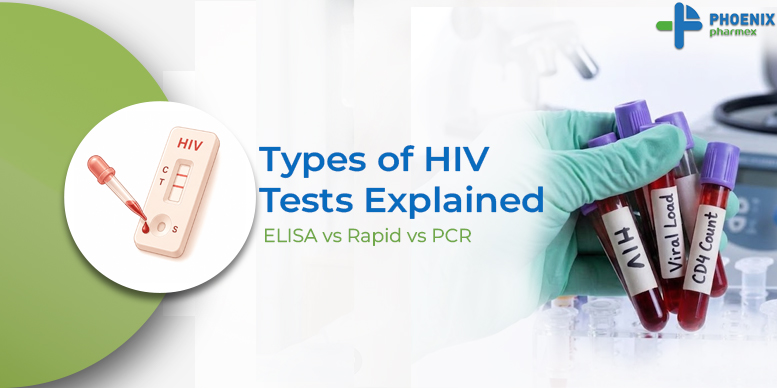
Types of HIV Tests Explained: ELISA vs Rapid vs PCR
When waiting for answers feels overwhelming, understanding the testing process can make uncertainty feel more structured and structure often brings calm.
The Question That Usually Comes First
For many people, the most stressful part of HIV testing is not the test itself, it is the uncertainty that comes before it. Questions begin to surface quietly: Which HIV test should I take? Why are there different types? What if I test too early?
This is where a common misunderstanding often appears. Different HIV tests are not “better” or “worse” versions of the same test. Each one is designed for a different timeline and a different purpose. Some tests look for the virus itself, while others look for the body’s response to it.
Understanding this changes the experience completely. Once you know what each test detects and when it works best, the process feels far more predictable and far less frightening. Modern HIV testing is highly accurate, widely accessible, and designed to provide clarity step by step, helping you move forward with informed understanding rather than uncertainty.
Why Are There Different HIV Tests?
HIV tests are designed to look for different signs of infection within the body. Some tests detect antibodies, which are the body’s response to HIV. Others look for antigens, which are parts of the virus itself, while some tests detect the virus’s genetic material (RNA) directly.
Because the body responds to HIV gradually, certain tests can identify infection earlier than others. This is why timing plays such an important role in HIV testing. Healthcare professionals choose specific tests based on factors such as the possible date of exposure, the presence of symptoms, the need for early detection, and whether follow-up confirmation is required.
Each test has a clear purpose. They are not meant to complicate the process—they work together to provide the most accurate and reliable understanding possible.
How HIV Testing Works?
After HIV enters the body, the immune system begins responding gradually over time. This process happens in stages. First, the virus itself may become detectable, followed by viral proteins known as antigens, and later, the body begins producing antibodies against HIV.
Different HIV tests are designed to detect different stages of this response. This is why some tests can identify infection earlier than others. The time between exposure and when a test can reliably detect HIV is known as the window period.
During this phase, a person may have HIV, but certain tests can still appear negative if taken too early. This is not because the test has failed, it is simply a matter of biology and timing. Understanding the window period helps make HIV testing feel more predictable and explains why follow-up testing may sometimes be recommended for accurate results.
ELISA Test: The Standard Laboratory Approach for HIV Testing
The ELISA test (Enzyme-Linked Immunosorbent Assay) is one of the most widely used laboratory tests for HIV screening. Modern ELISA tests are typically 4th-generation tests, which means they are designed to detect both:
HIV antibodies – the body’s response to the virus
HIV p24 antigen – a protein from the virus itself
Because it detects both antigens and antibodies, the ELISA test can identify HIV earlier than older antibody-only tests.
Typical Detection Window
Usually reliable around 18–45 days after exposure
Advantages of ELISA Testing
Highly accurate
Widely available
Commonly used for routine HIV screening
Limitations
Requires laboratory processing
Results may take longer than rapid tests
Overall, ELISA testing is often considered the standard balance between accuracy, early detection, and accessibility providing reliable results through a structured laboratory process.
Rapid HIV Tests: Faster Results with Different Timing
Rapid HIV tests are designed to provide results quickly sometimes within as little as 20 minutes. Most rapid tests work by detecting HIV antibodies, which are produced by the body in response to the virus.
These tests may use:
Finger-prick blood samples
Oral fluid samples
Typical Detection Window
Usually reliable around 23–90 days after exposure
Advantages of Rapid HIV Tests
Quick results
Convenient and easy to access
Useful for community screening and home testing
Limitations
May not detect very recent infections
Positive results usually require confirmatory laboratory testing
Rapid HIV tests play an important role because they make testing simpler, faster, and more accessible. And when testing becomes easier to access, awareness and early understanding naturally improve.
PCR / NAT Testing: Detecting HIV at the Earliest Stage
PCR tests (Polymerase Chain Reaction)—also known as NAT tests (Nucleic Acid Tests)—work differently from standard HIV tests because they detect the virus itself by identifying HIV RNA in the blood. Since they look directly for the virus rather than the body’s response to it, they can detect infection much earlier.
Typical Detection Window
Usually reliable around 10–14 days after exposure
Advantages of PCR / NAT Testing
Earliest detection option available
Useful after high-risk exposure
Helpful in newborn testing and more complex medical situations
Limitations
More expensive than routine HIV tests
Not commonly used for standard screening
May not be available in all healthcare settings
PCR testing is often recommended when very early detection is important, helping healthcare professionals gain clarity during the earliest stages after possible exposure.
Why HIV Test Results May Differ?
Different people may test positive for HIV at different times after exposure, and this variation is a normal part of how the body responds to infection. The timing of a positive result can depend on factors such as an individual’s immune response, the type of HIV test used, the timing of the test itself, and natural differences in biology.
Because of this, a negative test taken too early may sometimes need to be repeated later for confirmation. This does not mean something is wrong or that the test has failed, it simply means the body may not yet have reached the stage that a particular test is designed to detect. HIV testing is often a process guided by timing and follow-up, rather than a single moment of certainty.
Preparing for HIV Testing Without Fear
If you are planning to get tested for HIV, it is completely natural to feel uncertain. Much of this uncertainty often comes from not knowing which test is appropriate or when testing should be done. What helps most is understanding which test matches your timeline, learning about the window period, and asking healthcare professionals which option best fits your situation.
HIV testing today is designed to be:
Confidential
Widely available
Often low-cost or free
You are not expected to navigate the process alone. Healthcare providers guide testing step by step, helping you understand results, timing, and follow-up if needed. And when the process becomes clearer, fear naturally becomes smaller.
HIV Testing as Part of Routine Health Care
For many people, HIV testing becomes a routine part of overall health awareness similar to other preventive screenings and regular health check-ups. People choose to get tested for many different reasons, including routine medical care, new relationships, pregnancy care, or simply for peace of mind after a period of uncertainty.
Testing is not a sign of irresponsibility. It is a sign of awareness, self-care, and taking an informed approach to health. And when treatment or follow-up is needed, early detection allows earlier support, clearer planning, and better long-term health outcomes. Over time, HIV testing becomes less about fear and more about maintaining confidence and clarity in your health decisions.
A Grounded Perspective on HIV Testing
HIV testing is not about fear, it is about replacing uncertainty with clear and reliable information. ELISA tests, rapid tests, and PCR/NAT tests each serve a different purpose, depending on timing, exposure history, and clinical needs. They are designed to work together, helping healthcare professionals understand different stages of possible infection with greater accuracy.
When you understand how these tests work and why timing matters, the process becomes far less confusing and much more manageable. And for many people, that sense of manageability knowing what the next step is and why it matters is what brings the greatest reassurance.
Frequently Asked Questions About HIV Testing
1. Which HIV test is the most accurate?
All approved HIV tests are highly accurate when taken at the appropriate time after exposure. The accuracy depends largely on the timing of the test and the type of test used.
2. Which test detects HIV the earliest?
PCR or NAT (Nucleic Acid Test) can usually detect HIV the earliest, often within 10–14 days after exposure. These tests look directly for the virus rather than antibodies.
3. Can rapid tests miss early infection?
Yes. Rapid antibody tests may not detect very recent infection during the “window period,” when the body has not yet produced enough antibodies to be detected.
4. What happens if a test is positive?
If a screening test is positive, additional confirmatory testing is usually performed before a final diagnosis is made. This helps ensure accurate and reliable results.
5. Is HIV testing confidential?
Yes. HIV testing is private and handled confidentially in healthcare settings. Many clinics also provide supportive counseling along with testing services.
Reference
https://jmitra.co.in/elisa-test-is-better-than-a-rapid-or-an-rt-pcr-test/
https://www.hiv.gov/hiv-basics/hiv-testing/learn-about-hiv-testing/hiv-testing-overview
https://hiv.guidelines.org.au/management/virological-tests/hiv-antibody-and-antigen-testing/
Disclaimer:
The information in this article is provided for educational and awareness purposes only and should not be considered medical advice, diagnosis, or treatment guidance. Health conditions vary among individuals, and readers should consult qualified healthcare professionals for personalized medical recommendations. Phoenix Pharmex supports access to reliable health information but does not provide medical consultation through this content. Any medicines or therapies mentioned are for informational reference only and should be used under the supervision of licensed medical practitioners.


.png)
.png)
.png)
 Login with Facebook
 Login with Google
